

The automotive industry needs advanced materials to increase vehicle performance, reduce fuel consumption, and increase durability. Materials, such as polypropylene, lightweight composites, high-strength steels, and aluminum improve vehicle safety and durability. Innovation in materials supports the production of fuel-efficient or electric vehicles. They increase battery life and reduce energy consumption. Thus, automotive production is moving towards more efficient and environmentally friendly transportation solutions. PP, as a versatile, lightweight, and cost-effective polymer could revolutionize the automobile industry. Its durability, chemical resistance, and recyclability make it ideal for interior and exterior automotive parts and under the hood.
The Shobeir Shimi Company is a specialist provider of high-quality PP products for the automotive industry. The company offers a variety of PP grades designed to meet the specific needs of automotive manufacturing, including durability, heat resistance, and impact resistance. These materials are used in interior trim, bumpers, dashboards, and under-hood components, contributing to vehicle styling and fuel efficiency. With a focus on innovation, consistency, and customer satisfaction, Shobeir Shimi Company supports automotive manufacturers in producing more tolerable, cost-effective, and high-performance vehicles.
What are the key Properties of PP for Automotive Applications?
Reasons why polypropylene is well-suited for use in vehicles:
- It lowers the overall weight of an automobile, which improves fuel efficiency and reduces harmful emissions.
- It provides strong, long-lasting performance while remaining lightweight and compact.
- It Resists harsh chemicals and physical impacts.
- It is highly cost-effective and generally more affordable than metals like aluminum or steel and even many other engineering polymers.
- Its recyclability reduces waste, lowers environmental impact, and promotes eco-friendly production. These qualities make it ideal for sustainable automotive manufacturing.
- It is easily moldable, allowing complex shapes and precise components to be manufactured efficiently. It reduces production time and material waste.
- It is UV-stable and resists sun damage, preventing fading, cracking, or degradation from prolonged sunlight exposure.
Compared to steel or aluminum it has low production and processing costs, combined with ease of molding and recycling. These properties help manufacturers reduce overall production expenses while maintaining quality. PP is more heat-resistant and rigid than polyethylene. This makes it better for automotive applications. Polyethylene, though more flexible and impact-resistant, is less suitable for high-temperature environments. For a clearer comparison between PP and similar polymers like polyethylene, explore our in-depth guide, “Polypropylene vs. Polyethylene: Which Is the Better Choice?”
What are the applications of Polypropylene in Vehicles?
Comprehensive applications of PP in today’s automobiles include:
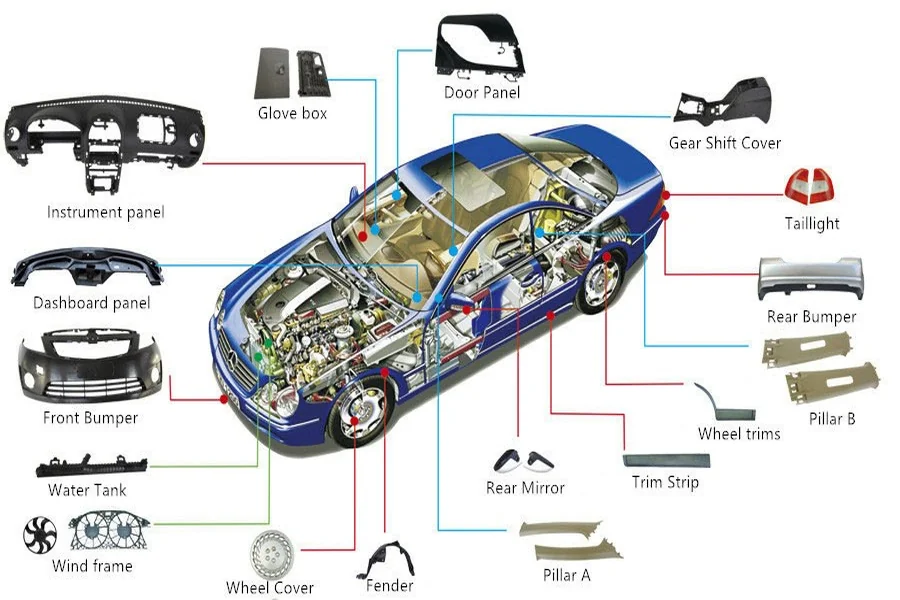
- PP is commonly used in exterior components like bumpers, body panels, and grilles due to its excellent impact resistance and versatility in design and appearance.
- PP is extensively utilized in interior vehicle components like dashboards, door panels, and center consoles. It has excellent durability, impact resistance, and resistance to damage, and is easily shaped into various stylish and functional designs. As a result, it is a preferred material for automotive interior components.
- PP is widely used in under-the-hood applications like fluid reservoirs, battery boxes, and air intake manifolds because of its cost-effectiveness and moldability. Its heat and chemical resistance make it well-suited for manufacturing these components.
- PP fibers are widely used in automotive textiles such as carpets, seat covers, and trunk liners. It is due to their strong durability, resistance to stains and moisture, ease of cleaning, and ability to withstand heavy daily wear and tear.
- PP is used in electric vehicles (EVs) to reduce overall weight, improving battery efficiency and driving range. It’s also found in battery casings, cable insulation, lightweight bumpers, and noise-reducing interior panels.
What are the benefits of Polypropylene in Automotive Manufacturing?
Polypropylene plays an effective role in advancing modern vehicle design by offering a unique combination of properties that directly contribute to improved performance, efficiency, and sustainability. PP contributes to better vehicles including:
- The lightweight nature of PP helps reduce the overall mass of vehicles. This is especially important in traditional combustion-engine cars and electric vehicles (EVs). Because weight reduction translates into better fuel economy and extended battery range. By replacing heavier materials like metal or denser plastics, PP enables manufacturers to meet environmental and fuel efficiency standards.
- PP is durable, and resistant to impact, chemical exposure, and wear. These properties make it ideal for components that experience frequent use or harsh conditions. These parts include bumpers, under-the-hood parts, and interior panels. The PP uses results in longer-lasting parts that require less maintenance and replacement, reducing costs over a vehicle’s lifetime.
- From a manufacturing perspective, PP is highly moldable. It enables the production of complex, integrated parts quickly and cost-effectively. This not only improves production efficiency but also supports innovative design possibilities which enables sleeker, more functional vehicle interiors and exteriors.
- PP supports environmental sustainability efforts due to its recyclability. It can be melted down and used again to make new parts. This supports recycling, reduces waste, and helps car makers be more environmentally friendly.
- PP contributes to better vehicles by making them lighter, more efficient, cost-effective, durable, and environmentally friendly.
All of the above properties are critical for meeting the evolving demands of today’s automotive industry. By using lightweight, durable, and recyclable materials like PP, manufacturers can produce more fuel-efficient and eco-friendly vehicles besides reducing vehicle weight. These advantages help them comply with international regulations on emissions, energy consumption, and sustainable manufacturing practices across global markets.
What is the role of polypropylene in future innovations in automotive manufacturing?
- PP is a low-density polymer that can reduce vehicle weight without sacrificing strength.
- Lightweight design reduces fuel consumption in combustion vehicles and increases battery range in electric vehicles.
- Advanced PP composites may be reinforced with glass/carbon fibers and used in structural components.
- Producing PP from renewable resources may further reduce carbon footprint.
PP’s versatility allows it to be integrated with smart technologies. For example:
- Production of self-healing PP composites for use in durable automotive interiors.
- Sound-absorbing PP foams for quieter cabins in electric vehicles.
- Self-cleaning PP sheets for hydrophobic coatings.
- PP is cheaper than many alternatives such as ABS and polycarbonate making it cost-effective for large-scale manufacturing of electric vehicles. It is also compatible with injection molding, which allows for complex and lightweight designs (such as air ducts and battery boxes).
Conclusion: Does this discussion recommend using PP in the automotive industry?
According to the following characteristics, polypropylene plays a vital role in shaping the future of automotive design by helping to develop lighter, stronger, and more sustainable vehicles:
- Its excellent strength-to-weight ratio enables manufacturers to reduce the overall weight of the vehicle, thereby improving fuel efficiency and reducing carbon emissions.
- PP’s resistance to chemicals and impact makes it ideal for interior and exterior automotive applications.
- Due to PP’s versatility, it can be molded into complex shapes and produced in many automotive parts.
- PP’s affordability, recyclability, and cost-effectiveness make it a suitable material for large-scale automotive production.
As the automotive industry shifts towards electric vehicles and environmentally responsible manufacturing, PP is well-aligned with these trends. PP must continue to improve to meet the needs of today’s environmentally friendly vehicles. We recommend you discover the benefits of high-quality PP like lightweight, durable, and sustainable designed to meet today’s automotive challenges. You can achieve innovation and efficiency for your vehicles through smart and reliable choices.
