

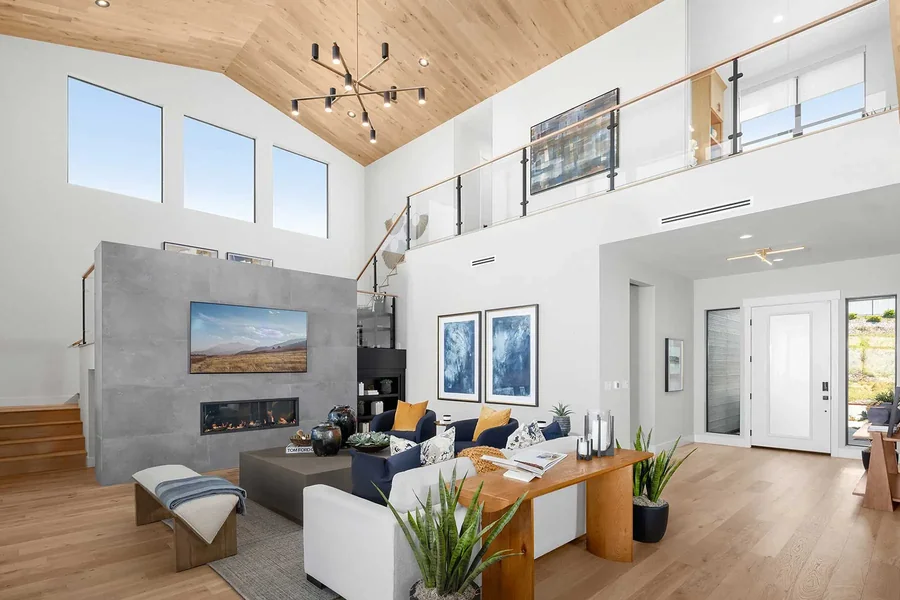
The townhouse has always asked its occupants to think differently about space. Without the sprawl of a single-level home, without the luxury of a wide floor plate, the townhouse offers instead something more interesting: height. And height, in the hands of a thoughtful designer, becomes not a constraint but a genuine asset that single-level homes rarely achieve.
Understanding how vertical space is used in the best-designed townhouses changes how you evaluate the homes you look at and the choices you make when designing or renovating one.
Light as a Vertical Resource
In a single-level home, natural light comes primarily from windows in the walls. In a multi-storey townhouse, light becomes a three-dimensional resource that can be drawn into the home from above as well as from the sides.
Skylights positioned over stairs, voids, and key living spaces allow light to penetrate deep into the home, reaching levels that wall windows cannot serve effectively. A skylight over a central staircase illuminates every level it passes through, creating a column of light that makes the vertical journey through the home feel connected and bright rather than corridor-like and enclosed.
In terraced townhouse designs where side windows are unavailable and rear windows limited by overlooking constraints, vertical access to light is not a luxury. It is frequently the difference between a home that feels bright and alive and one that feels permanently dim.
Connecting Levels Without Losing Privacy
One of the tensions in vertical living is the relationship between connection and privacy. Families with children, couples who work from home, and multi-generational households all need their levels to feel connected but also to provide genuine acoustic and visual separation when required.
The best townhouse designs navigate this tension through a combination of spatial arrangement and material choices. Voids that connect living levels visually while positioned away from bedrooms. Flooring materials that absorb sound between levels. Door configurations that allow levels to be opened or closed off depending on the needs of the occupants.
This calibrated approach to connection and separation distinguishes genuinely liveable vertical homes from those that feel either claustrophobically isolated between floors or uncomfortably exposed throughout.
Thinking Vertically About Storage
Storage in a townhouse is an exercise in creativity that single-level homes rarely demand. The transitions between floors, the voids beneath stairs, the spaces that would be awkward to occupy but perfectly suited to built-in storage, all of these require deliberate planning from the earliest design stages.
Homes that approach storage as an afterthought, adding it wherever space remains after primary layout decisions, consistently produce less liveable results than those that treat storage as a fundamental design element shaping the entire plan.
The Reward of Thinking Up Rather Than Out
The townhouse offers its occupants a fundamentally different spatial experience from the single-level home. Moving through a home vertically, experiencing different qualities of light on different levels, occupying spaces that feel larger than their floor area because of generous ceiling heights and well-placed voids, is a genuinely different and often deeply rewarding way to live.
The homes that deliver this reward most effectively are those designed by people who understand vertical living not as a compromise but as an opportunity, and who bring the skill and discipline to realise that opportunity in full.
