

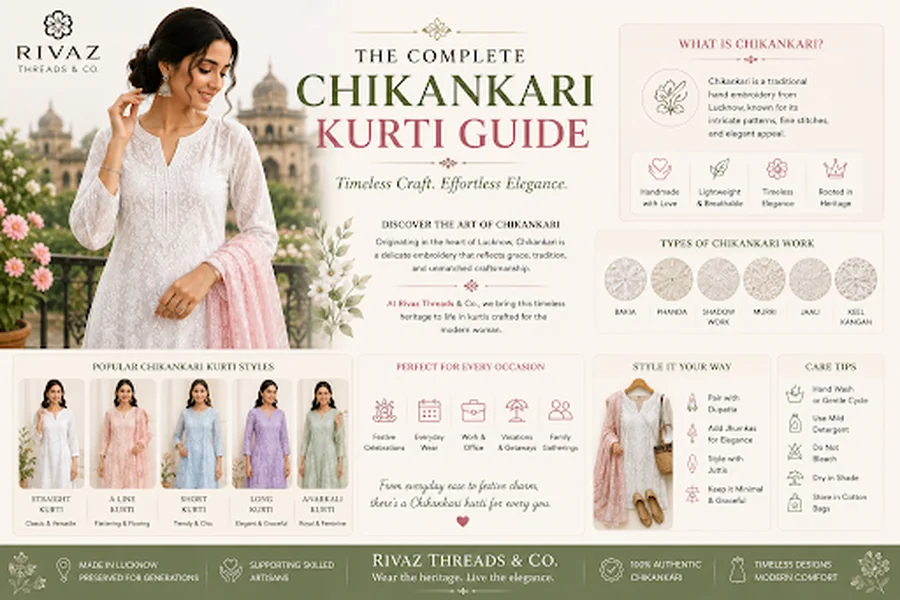
Walk into any wedding, office, or Sunday brunch in India today and you’ll spot a Chikankari kurti somewhere in the room. It’s one of the rare pieces of ethnic wear that moves as easily between a boardroom and a baraat, which is why a well-curated Chikankari kurti collection tends to become the most-worn shelf in a woman’s wardrobe. That versatility is exactly why so many buyers go straight to a dedicated Chikankari kurti online collection rather than hunting through generic ethnic-wear listings.
But the sheer number of options can be overwhelming: short kurti or long Anarkali, cotton or mulmul, machine work or hand embroidery. This guide breaks down everything you need to know before you buy — so the kurti you choose actually earns its place in your wardrobe.
What Makes a Kurti “Chikankari”?
Chikankari kurti refers to a kurti hand-embroidered using Lucknow’s traditional white-thread needlework technique, typically on lightweight, breathable fabric.
Chikankari is a centuries-old hand embroidery tradition that originated in Lucknow, India, believed to date back to the Mughal era. The word itself is thought to come from the Persian “chikan,” referring to delicate needlework. What sets it apart from other embroidery styles is the technique: fine, mostly white or tonal thread worked into intricate floral and paisley motifs, traditionally on lightweight fabrics like mulmul, muslin, and cotton, so the embroidery breathes rather than weighs the garment down.
A genuine Chikankari kurti isn’t just decorated — it’s crafted stitch by stitch by artisans who often specialize in a single stitch type (there are over 30 traditional Chikankari stitches, including tepchi, bakhiya, and jaali work). That’s the craft you’re paying for, and it’s worth knowing how to recognize it.
Handmade vs. Machine-Made: How to Tell the Difference
Not every kurti labeled “Chikankari” is hand-embroidered, and the difference matters both for price and for longevity. Here’s how to check before you buy:
- Look at the back of the fabric. Hand-embroidered Chikankari shows slightly irregular stitches on the reverse — a sign of human hands, not a machine template. Machine work tends to look identical on both sides.
- Touch the thread. Handwork uses finer, softer thread and feels slightly raised and textured. Machine embroidery often uses thicker thread and sits flatter.
- Check for perfect symmetry. Ironically, if every motif looks mathematically identical, it’s likely machine-made. Genuine hand-done Chikankari has small, natural variations between motifs.
- Ask about the artisan. Brands that work directly with Lucknow’s karigars (artisans) can usually tell you which stitch techniques were used and roughly how many hours a piece took. That traceability is a good trust signal.
At Rivaz Threads & Co., every kurti is genuine handmade Chikankari, worked by artisans in Lucknow — not printed or machine-replicated. You can see the hand-finished detailing up close on a piece like the:
Chikankari Kurti Styles: Which Silhouette Suits You
Short Kurti
Hits around hip to mid-thigh length, usually paired with jeans, palazzos, or straight pants. This is the easiest entry point into Chikankari — ideal for college, casual outings, and everyday wear where you want the embroidery to read as detail, not the whole outfit.
Straight-Cut Kurti
Falls knee-length or below in a clean, unflared cut. This is the workhorse silhouette for office wear — polished enough for meetings, comfortable enough for a full day, and easy to dress up with a dupatta for evening plans.
A-Line Kurti
Fitted at the waist and flaring gently outward, the A-line is the most universally flattering Chikankari cut, which is why it’s become a go-to for everyday and festive wear alike. The gentle flare also gives the embroidery room to move.
Anarkali / Long Gown
Floor-length or near-floor-length with a fuller flare, the Anarkali is the most traditional and dramatic silhouette — the one you reach for during weddings, Eid, Teej, and other occasions that call for a statement. A piece like the:
Chikankari Kurti Long Gown with Bell Sleeves and Ghaspatti Work captures exactly this — dramatic, floor-length, and finished with hand embroidery.
Fabric Guide: Which Chikankari Fabric to Pick
The best fabric for a Chikankari kurti depends on the season: mulmul and muslin suit hot, humid weather; cotton suits daily and office wear; kota doria and chanderi suit festive occasions.
The fabric changes how a Chikankari kurti drapes, breathes, and ages — and it’s often a bigger factor in comfort than the embroidery itself.
- Cotton — the most durable and low-maintenance option, ideal for daily and office wear. Structured enough to hold its shape through a full workday.
- Mulmul — an ultra-fine, breathable weave of cotton, prized for its softness and airy feel; excellent for peak summer and long fasting days like Sawan Somwar.
- Muslin — similarly lightweight and soft-draping, often used for kurtis with a gentle fall and subtle sheen, well suited to shadow-work embroidery styles.
- Kota Doria — a light, slightly textured weave with an almost translucent quality, popular for its airy feel and understated shine — a good festive-meets-casual middle ground, as seen in the Hoor Pure Kota Doria Chikankari Kurti.
- Chanderi — known for its sheen and crisp drape, chanderi Chikankari kurtis lean more festive and are a strong pick for daytime wedding functions.
Two fabric pairings worth a closer look: the Hoor Pure Kota Doria Chikankari Kurti in Green, and the softer-draping
Hoor Pure Muslin Chikankari Kurti with Shadow Fanda Work, which shows how muslin lets shadow-work embroidery read through the fabric.
How to Style a Chikankari Kurti
Chikankari’s biggest strength is that the embroidery does the talking, so styling stays simple:
- Pair a short or straight kurti with straight-cut or palazzo bottoms for everyday and office wear.
- Layer an Anarkali-style kurti with statement jhumkas and a matching or contrasting dupatta for festive occasions.
- Coordinate with a partner or bridesmaids using a Chikankari co-ord set for a put-together group look at weddings.
- Stick to minimal jewelry when the embroidery is dense — let the handwork be the focal point rather than competing with it.
Caring for Your Chikankari Kurti
- Hand wash in cold water where possible, especially for mulmul and muslin pieces, to protect the embroidery thread.
- Avoid wringing — gently squeeze out water and dry flat or on a padded hanger to preserve the drape.
- Iron on the reverse side, or use a pressing cloth, to avoid flattening the raised stitch work.
- Store folded rather than on thin hangers for heavier Anarkali styles, to avoid stress on the shoulder seams.
Frequently Asked Questions
Is Chikankari kurti suitable for daily wear?
Yes. Short and straight-cut Chikankari kurtis in cotton are specifically suited to daily and office wear — the embroidery is subtle enough not to look overdressed, and cotton holds up well to regular washing.
How do I know if a Chikankari kurti is handmade?
Check the reverse side of the fabric for slightly irregular stitching, feel for finer thread with a bit of texture, and buy from brands that can confirm the piece was hand-embroidered by artisans rather than machine-replicated.
What is the best fabric for Chikankari kurti in summer?
Mulmul and muslin are the best choices for summer — both are lightweight, breathable cotton weaves that stay comfortable through long, hot days.
Can Chikankari kurtis be worn for weddings?
Yes, particularly Anarkali and long-gown silhouettes in chanderi or richer embroidery patterns, which read as festive without the weight of heavier bridal wear.
Shop the Collection
Every kurti mentioned in this guide is genuine handmade Chikankari from Lucknow, ready to ship. Explore the full range and filter by silhouette, fabric, or color to find yours.
Browse the full Chikankari Kurtis collection — or start with the ready-to-style
Hoor Pure Muslin Chikankari Kurti with Straight Pants in Magenta Ombre, a complete outfit in one piece.
